Agentic AI in L&D: How to Move from Pilots to Trusted Workflows
Why Agentic AI in L&D Is Really a Workflow Challenge

AI is no longer a future topic for L&D. It is an implementation challenge. New findings from McKinsey and our State of Learning Technologies 2026 report point to the same conclusion: adoption is rising, but scaling remains hard. Agentic AI is moving past the realm of experimentation, yet value will not come from simply adding more tools. It will come from redesigning workflows, building AI literacy, connecting learning to skills and performance, and creating the trust, governance, and evidence needed to scale.
How to move from pilots to trusted workflows
AI has moved beyond conference buzz and isolated chatbot experiments. Both our State of Learning Technologies 2026 report and McKinsey's latest AI study show the same pattern: AI use is broadening, but scaling it remains difficult (see figure 1). In our research, AI has become an operational reality for enterprise L&D, with topics like integration, security, and trustworthy governance now acting as the real bottlenecks. McKinsey reaches a similar conclusion at enterprise level: adoption is expanding fast, but most organisations are still in experimentation or pilot mode and have not yet embedded AI deeply enough into workflows to create genuine enterprise-wide value.
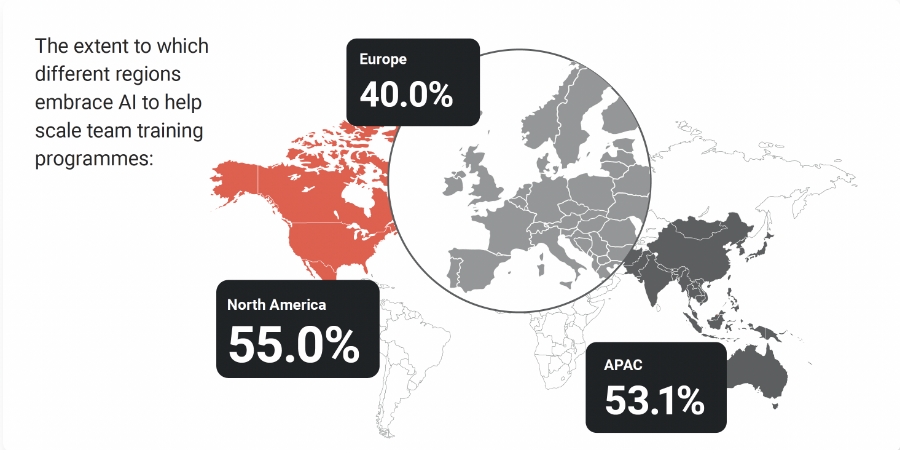
Figure 1: Our findings from the latest State of Learning Technologies Report illustrate regional variations in the adoption of AI for scaling training programs.
AI isn't up for debate, but how it's deployed is.
One of the clearest findings in our report is that the nature of the challenge surrounding artificial intelligence has shifted. L&D is no longer asking whether AI belongs in learning. It is instead asking how to connect it, govern it, and prove that it works. More than half of respondents cite integrating AI or new learning technologies effectively as their biggest challenge (see figure 2). At the same time, the learning stack is consolidating around a central LMS backbone, while investment moves toward AI-powered authoring, coaching, analytics, and skills infrastructure.
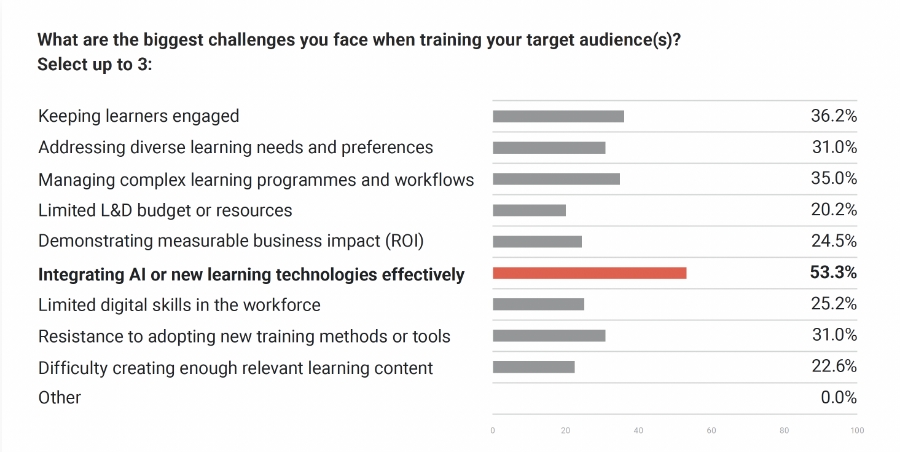
Figure 2: Integrating learning technologies remains a top global L&D challenge for more than half of all organizations.
That shift matters because it changes the role of L&D. The question is about how to make AI work inside real learning ecosystems, real skills strategies, and real business processes, as opposed to just isolated use cases. The organisations that progress the furthest will not be the ones with the most tools. They will be the ones that can connect learning to skills, skills to performance, and AI to workflows that the business can trust.
What agentic AI actually changes for L&D
McKinsey defines AI agents as systems that can plan and execute multiple steps in a workflow. Their survey shows strong interest, but also a reality check: 62 percent of respondents say their organisations are at least experimenting with AI agents, while 23 percent say they are scaling an agentic AI system somewhere in the enterprise. Even then, scaled use in any single function remains limited.
For L&D, that makes agentic AI interesting for a practical reason: It points to a move away from one-off prompting and towards workflow-based support. That can mean helping teams create content faster, recommend relevant resources, support learners in context, identify skill gaps sooner, or guide practice and feedback more dynamically. In our report, respondents describe the next game-changer not simply as “AI,” but as practical support that helps people learn while working, together with better skills visibility and more adaptive systems. One of the clearest signals in the report is the phrase: “Agentic AI, not just chatbots.”
The real opportunity is workflow redesign
This is where the broader McKinsey findings are especially useful. Their strongest message is not just that AI is spreading. It is that organisations seeing the greatest value are more likely to redesign workflows, pursue innovation alongside efficiency, and embed AI into how work actually gets done. That matters for L&D because AI creates the most value when it is not treated as a bolt-on feature, but as part of a broader redesign of content operations, performance support, skills development, and learner guidance.
Our own research supports a similar takeaway. Integration into existing systems, strong training and communication for users, and clear KPIs are all among the most important factors for successful implementation. Engagement is strongest when learning is embedded into daily workflows, not separated from them. That is the real promise of agentic AI for L&D: less friction when it comes to fostering learning within an organisation.
Why trust is the real scaling factor
Agentic AI will not scale in learning because it sounds advanced. It will scale if people trust it. In our report, AI adoption is increasingly tied to questions of data security, reliability, privacy, compliance, and human oversight. The report is explicit: AI adoption is accelerating, but trust and governance will decide who can scale.
The older whitepaper still adds an important perspective here, showing how many organisations hesitate because of legacy systems, lack of expertise, resistance to change, and concerns around confidentiality and compliance. It also argues that strategic AI implementation requires investment in infrastructure, skills, and change management, and not just enthusiasm for the technology itself. Finally, governance shouldn't be viewed as a barrier to adoption. It is part of what makes adoption possible.
From content efficiency to capability building
The most straightforward advantages of AI in L&D still concern speed: Faster content creation, lower admin load, quicker updates, and better scalability all matter. The whitepaper captures this clearly, especially around AI-enabled content creation, automated LMS processes, and scalable learning delivery.
But the bigger opportunity also involves capability building. Our 2026 report shows that measurement is moving from activity to outcomes, with productivity, skills improvement, and skills gap analysis becoming more central. It also shows that AI readiness and automation readiness are now the top skills priorities for L&D. In other words, the next phase of AI in learning is about more than just doing existing work faster, but also helping people and organisations to become more capable, adaptable, and measurable over time (see figure 3).
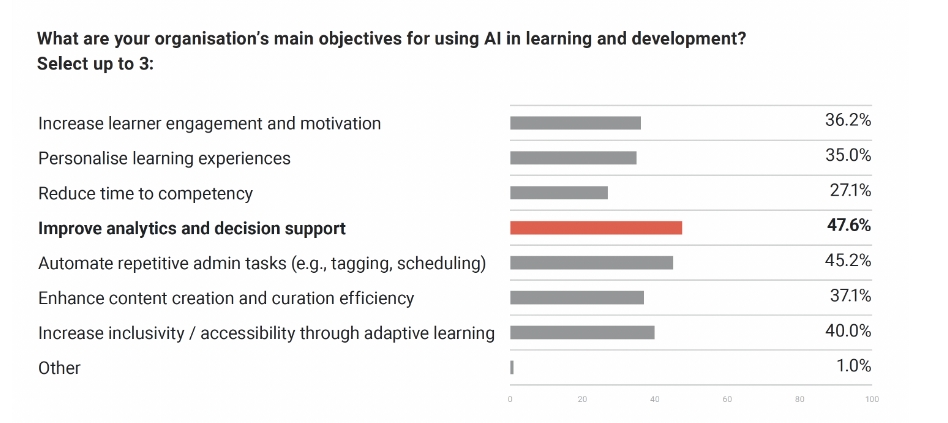
Figure 3: Improving analytics and enhancing decision support are among the primary goals for organizations using AI in L&D.
That is where the whitepaper’s seven AI impact areas remain useful as a framing device: efficiency, individualisation, intelligent support, automated competency tracking, content curation, predictive workforce development, and enhanced engagement. Together, they translate the AI conversation into concrete L&D levers rather than abstract hype.
What L&D leaders should focus on now
The practical takeaway remains that agentic AI will create only value in L&D when it is tied to real workflows, trusted by users, connected to skills and performance, and positioned as more than a pure efficiency play. For learning leaders, that means focusing less on AI as a feature set and more on the conditions that make it useful at scale.
- Don't focus on tools, focus on workflows
Start with the moments where learning friction is highest: content creation, onboarding, learner support, coaching, skills mapping, assessment, or performance enablement. Agentic AI becomes meaningful when it reduces friction in those workflows, not when it sits beside them as a separate experiment.
That remains a key shift, and since many organisations already have access to AI tools, the key difference will lie in whether they purposefully redesign the surrounding workflow so that AI can support it in a structured, repeatable way. In practice, that could mean speeding up course creation, surfacing relevant learning support in context, improving skills visibility, or guiding learners more dynamically based on role, progress, and need. The question should not be “Where can we add AI?” but “Where is friction slowing learning down, and how could AI help remove it?”
- Build for trust from the beginning
AI in L&D will not scale just because it sounds innovative. It will scale when learners, managers, and stakeholders trust how it works. That means governance, transparent use policies, human oversight, clear ownership, and implementing practical safeguards around privacy, compliance, and output quality.
This is especially important for agentic AI, because the more systems take on multi-step support tasks, the more important it becomes to define where human review is needed and who remains accountable. Trust is not a final-stage concern once implementation is already under way. It is one of the foundations of successful implementation. If people do not trust the logic, the data handling, or the quality of outputs, adoption will remain shallow no matter how advanced the technology looks.
- Connect AI to skills and performance
AI initiatives in learning will struggle to sustain momentum if they remain side projects or innovation showcases. The stronger approach is to tie them directly to capability-building: identifying needs faster, personalising support, accelerating time to competence, improving skills visibility, and creating stronger links between learning activity and business outcomes.
This is where L&D has a real opportunity. AI should not only make learning operations faster; it should help organisations become more capable and more adaptive. That means connecting AI use cases to role readiness, workforce development, internal mobility, and measurable performance improvement. If AI helps create better content but does not improve capability or decision-making, it still only offers comparatively little extra value. While if it helps move people faster from learning to applied performance, the case becomes much stronger.
- Keep the value of AI broader than "efficiency" alone
Efficiency is often the easiest place to begin. Faster authoring, lower admin load, quicker updates, and more scalable content delivery are all real and important gains. But they should not be the end of the story.
The organisations getting the most out of AI tend to use it not only to save time, but also to redesign experiences, improve decision support, and enable new forms of learning and capability-building. For L&D, that means thinking beyond automation and asking bigger questions: How can AI make learning more relevant in the flow of work? How can it strengthen coaching and practice? How can it support managers better? How can it help surface and develop skills over time? The most compelling AI strategy is not one that simply reduces effort. It is one that increases organisational capability.
The next challenge for L&D
The era of AI as a talking point is over. The next challenge for L&D is making it work: inside the learning stack, inside daily workflows, and inside a performance story the business can understand. Agentic AI matters because it moves the conversation beyond isolated prompts and toward coordinated support, decision assistance, and learning in the flow of work. The organisations that move furthest will not be the ones chasing the next label. They will be the ones that combine AI capability with human judgment, governance, and a clear view of impact.

State of Learning Technologies 2026
Explore our latest industry report on AI adoption, skills priorities, implementation barriers, and what enterprise L&D teams need in order to scale learning technologies with confidence.

The State of AI in 2025, McKinsey
See the wider enterprise picture on AI maturity, agentic experimentation, workflow redesign, and the gap between adoption and scalable value.

AI in the Future of Enterprise Learning
Read our whitepaper on seven practical areas where AI can support L&D, from efficiency and personalisation to intelligent support and predictive workforce development.