The Complete Guide to Learning Management Systems (LMS)

In today’s fast-paced business world, organisations are under increasing pressure to develop talent, ensure regulatory compliance, and keep pace with digital transformation. A robust learning management system (LMS) for enterprise has become a critical tool for achieving these goals.
From AI-powered training and blended learning to seamless integration with HR, ERP, and CRM systems, modern enterprise learning platforms enable organisations to deliver scalable, personalised learning experiences to thousands – or even millions – of employees, partners, and customers worldwide.
This comprehensive guide explains what an enterprise LMS is, highlights key features and current trends, and provides actionable advice on choosing the right solution for your organisation’s learning and development strategy.
1. What is an enterprise LMS – and why it matters for large organisations
Choosing the right learning management system has never been more critical. In an era shaped by hybrid work, global compliance demands, and AI-powered upskilling, organisations are seeking robust, scalable platforms that integrate seamlessly into their wider digital ecosystem. But which corporate learning platforms truly deliver at enterprise scale?
What is an enterprise LMS?
An enterprise LMS is a comprehensive learning management platform designed to deliver and manage complex, large-scale training programmes. Such systems typically support:
- tens of thousands of learners across global teams and business units
- multi-language content and multi-domain management
- blended learning (online, in-person, mobile)
- compliance, certification, and audit-ready reporting
- external training for partners, suppliers, and customers
- seamless integration with HR, ERP, and CRM systems
These platforms are not just learning portals – they are strategic tools for business resilience, workforce performance and continuous development. For example, a multinational manufacturer may use an enterprise LMS to train over 100,000 employees and partners across more than 50 countries, ensuring regulatory compliance and standardising onboarding processes.

Enterprise LMS vs. basic LMS
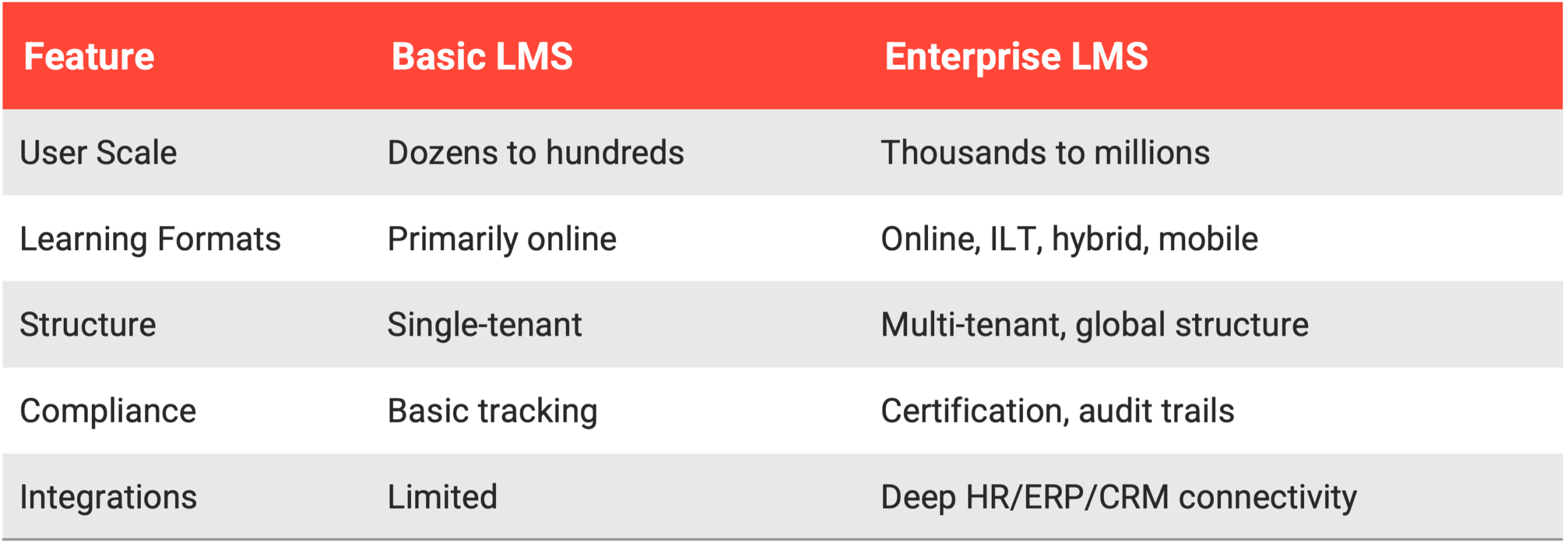
Why the right LMS matters now
The learning landscape is evolving rapidly. Modern learning management platforms are not just larger – they are smarter, more integrated, and more aligned with business goals.
Organisations now seek learning platforms that:
- support AI-generated content and personalisation
- enable learning within the flow of work
- link training to skill development and performance
- provide mobile, blended, and flexible delivery
- automate compliance and certification tracking
For regulated industries and global workforces, the right LMS reduces risk and simplifies operations while driving learner engagement and organisational growth.
2. Key features to look for in an enterprise LMS
Choosing a learning management system for enterprise use isn’t just about ticking boxes, it’s about finding a solution that can scale with your business, support diverse use cases, and integrate into your broader digital ecosystem. Below are the core capabilities to look for when evaluating enterprise-grade learning platforms.
A true enterprise LMS must support thousands (or even millions) of learners, without compromising performance. Multi-tenancy, the ability to manage multiple domains or learning portals under one system, is equally essential. It enables different business units, brands, or external partners to operate with their own look, feel, and content – all managed centrally.
Why it matters: Enables efficient global rollouts, ensures consistent experiences across entities and reduces operational costs.
In regulated industries, these features are critical. The learning management system should provide automated tracking, re-certification reminders, validation workflows, and audit trails to reduce legal risk and prove compliance at any time.
Look for: validated learning paths, role-based certification management and configurable compliance dashboards.
Enterprise learning is never one-size-fits-all. A modern enterprise LMS should support multiple delivery formats, including:
- eLearning (SCORM/xAPI)
- Instructor-led training (ILT)
- Virtual classrooms
- On-the-job training
- Mobile/offline learning
Prioritise LMS solutions that combine these formats into hybrid, AI-supported learning journeys.
Do you need to train partners, franchisees, or customers? Choose a learning management system that enables B2B/B2C learner management, public catalogues, e-commerce, and customisable access rights.
This is often the point where basic LMS platforms fall short of enterprise expectations.
An enterprise LMS should integrate tightly with your existing infrastructure – including HRIS (such as SAP or Workday), identity providers (LDAP, SSO), performance management tools, CRMs, and ERP platforms.
Why it matters: Minimises manual data entry, synchronises learner records, and connects training outcomes directly to measurable business KPIs.
Effective training requires measurable impact. Your learning management system should provide configurable dashboards, pre-built compliance reports, and real-time insights into learner progress, skill gaps, and engagement levels.
Look for: filtering options by business unit, geography, or role to identify localised strengths and gaps.
Some learning management platforms come with built-in authoring tools or integrations. AI-powered content creation (like imc Express or Docebo Shape) is increasingly becoming a differentiator.
Why it matters: Dramatically reduces time-to-training, empowers subject-matter experts to create content, and accelerates global localisation.
Advanced organisations increasingly demand headless LMS architecture – separating the front-end experience from the back-end engine. This approach allows full UI customisation, brand alignment and seamless embedding of learning into other digital experiences.
Use case: Retailers, manufacturers, and luxury brands training global networks under strict brand guidelines benefit most from this flexibility.
A modern learning platform for enterprise must offer full mobile functionality – not just a responsive interface, but native mobile apps with offline learning capabilities for field teams or global workforces.
Pro tip: Ensure the platform automatically synchronises progress once learners reconnect online.
While many platforms restrict you to fixed templates, an enterprise LMS like the imc Learning Suite offers configurable workflows, granular permissions, and tailored learning paths – all without the need for heavy custom development.
Final tip when it comes to choosing the right LMS
Choose a platform that matches not only your current needs but also your long-term growth path. Many enterprise LMS buyers outgrow their initial platform within two to three years – invest in a solution you won’t need to replace.

3. LMS trends to watch in 2026
Enterprise learning is evolving faster than ever. From shifting learner expectations to major technological breakthroughs, the 2026 landscape demands more flexibility, integration, and personalisation from LMS platforms. Below are the key trends shaping enterprise buying decisions in 2026 – and how leading learning management providers are responding.
More organisations are turning to AI-powered authoring tools to accelerate training production, cut costs and empower subject-matter experts to create content directly. Platforms such as the imc Learning Suite (with imc Express) and Docebo (with Shape) now include built-in tools that automate slide design, translations, voice-overs, localisation, and text generation.
Why it matters: Can reduce content creation time by up to 80% and eliminate bottlenecks in enterprise training delivery.
A growing number of enterprise buyers are now requesting headless LMS capabilities – where the back-end remains intact, but the learner interface can be fully customised or embedded into other systems such as intranets, portals or digital workplaces. This “headless learning architecture” gives organisations total control over the user experience.
Who’s leading: Platforms such as the imc Learning Suite and Totara already support headless delivery, while many others still rely on fixed, vendor-managed interfaces.
Learning is no longer a siloed function. Enterprise organisations now expect learning management platforms to integrate seamlessly with business-critical systems – including:
- HRIS and HCM suites (SAP, Workday, Oracle)
- CRM and partner portals
- ERP systems and performance tools
- Scheduling tools and compliance workflows
Example: The imc Learning Suite connects training outcomes directly to shift-planning and regulatory systems, enabling real-time validation and compliance tracking.
The standalone LXP (Learning Experience Platform) category is consolidating. Enterprise buyers increasingly expect unified learning platforms that combine experience-driven features – such as personalised recommendations, AI-curated content, and social collaboration, without compromising core LMS functionality.
Why it matters: Vendors like Valamis and 360Learning blur the lines, but enterprise buyers still prioritise compliance, structure, and scalability.
Despite the shift towards more flexible learning, compliance management remains essential across many industries. What’s changing is the delivery – it’s now embedded into workflows, validated in real time and reported with full traceability.
Key requirement: Choose a learning management system that automates recertification, audit trails and validation logic – not one that simply tracks completions.
There’s increasing demand for LMS platforms that enable a skills-first learning strategy – supporting skills taxonomy, tagging, gap analysis, and internal mobility. While talent-management giants such as Cornerstone and Workday lead this space, learning-first platforms like the imc Learning Suite are closing the gap through skill-based learning paths, AI-driven recommendations, and integrated career development tools.
AI-powered content creation and localisation
More organisations are turning to AI-powered authoring tools to accelerate training production, cut costs and empower subject-matter experts to create content directly. Platforms such as the imc Learning Suite (with imc Express) and Docebo (with Shape) now include built-in tools that automate slide design, translations, voice-overs, localisation and text generation.
Why it matters: Can reduce content creation time by up to 80% and eliminate bottlenecks in enterprise training delivery.
Headless LMS architecture
A growing number of enterprise buyers are now requesting headless LMS capabilities – where the back-end remains intact, but the learner interface can be fully customised or embedded into other systems such as intranets, portals, or digital workplaces. This “headless learning architecture” gives organisations total control over the user experience.
Who’s leading: Platforms such as the imc Learning Suite and Totara already support headless delivery, while many others still rely on fixed, vendor-managed interfaces.
Integration with business-critical systems
Learning is no longer a siloed function. Enterprise organisations now expect learning management platforms to integrate seamlessly with business-critical systems – including:
- HRIS and HCM suites (SAP, Workday, Oracle)
- CRM and partner portals
- ERP systems and performance tools
- Scheduling tools and compliance workflows
Example: The imc Learning Suite connects training outcomes directly to shift-planning and regulatory systems, enabling real-time validation and compliance tracking.
From LXP back to LMS
The standalone LXP (Learning Experience Platform) category is consolidating. Enterprise buyers increasingly expect unified learning platforms that combine experience-driven features – such as personalised recommendations, AI-curated content, and social collaboration, without compromising core LMS functionality.
Why it matters: Vendors like Valamis and 360Learning blur the lines, but enterprise buyers still prioritise compliance, structure, and scalability.
Compliance is evolving, not disappearing
Despite the shift towards more flexible learning, compliance management remains essential across many industries. What’s changing is the delivery – it’s now embedded into workflows, validated in real time, and reported with full traceability.
Key requirement: Choose a learning management system that automates recertification, audit trails, and validation logic – not one that simply tracks completions.
Skills-first learning strategies
There’s increasing demand for LMS platforms that enable a skills-first learning strategy – supporting skills taxonomy, tagging, gap analysis, and internal mobility. While talent-management giants such as Cornerstone and Workday lead this space, learning-first platforms like the imc Learning Suite are closing the gap through skill-based learning paths, AI-driven recommendations, and integrated career development tools.

4. How to choose the right learning management system
Selecting the right enterprise LMS is not just about comparing feature lists. It's about finding the best fit for your organisation's structure, learning objectives and long-term growth trajectory.
The following key evaluation criteria will help you make a confident, future-ready decision.
Step 1. Define your primary learning audience(s)
Ask: Who are we training and how diverse are their needs?
- Internal employees across multiple roles or regions?
- External learners (partners, franchisees, customers)?
- Blue-collar teams needing mobile or offline access?
Look for an LMS with multi-tenant architecture, external learner support, and flexibility to serve different use cases without duplicating administrative effort.
Step 2. Assess your compliance and risk landscape
If your organisation operates in compliance-driven industries, ensure the LMS can:
- automate certifications and re-training
- provide audit trails and real-time validation
- trigger compliance alerts tied to business workflows
Not all learning platforms offer genuine compliance automation. Don’t assume basic tracking is enough.
Step 3. Audit your integration requirements
Your enterprise LMS will deliver maximum value when it integrates seamlessly with your existing systems, including:
- HR systems (e.g. SAP, Workday, Personio)
- Performance tools
- ERP or CRM platforms
- Active Directory or SSO providers
Ensure that any shortlisted platform offers proven APIs or pre-built connectors for smooth enterprise systems integration.
Step 4. Match the platform to your content strategy
Consider your content strategy carefully before making your choice. Ask yourself:
- Will we create content in-house, with agencies, or both?
- Do we need rapid authoring or high-end learning experiences?
- Are translations and localisations a factor?
Also consider whether AI-powered content tools (e.g. imc Express), native authoring (such as Docebo), or support for third-party solutions (e.g. Articulate, SCORM) will be essential for your enterprise learning needs.
Step 5. Evaluate admin efficiency and future scalability
Think long-term: Will the learning management system help your L&D team achieve more with fewer resources? Look for a scalable enterprise LMS with:
- automated workflows and reporting
- configurable rules, not hardcoded workarounds
- a modular structure that grows with your organisation
Avoid platforms that demand excessive manual intervention, constant custom development, or full vendor dependence for routine changes.
Step 6. Don’t underestimate support and strategic partnership
Beyond the software, consider the vendor’s approach to:
- implementation and onboarding
- migration and change management
- long-term strategic guidance and roadmap transparency
Success with an enterprise LMS depends as much on the vendor partnership as on the platform itself.
Closing tip
Choose an enterprise LMS solution that matches your organisation’s complexity – not just its current size. As your business grows, compliance requirements and learning needs will evolve. The right platform will not only support your training today but will scale, adapt and integrate seamlessly with your broader enterprise ecosystem.

Ready to shortlist enterprise LMS solutions with confidence?
Choosing the right learning management system for enterprise is a strategic decision – especially when long-term scalability, regulatory compliance, and seamless business integration matter.
- Do you want help mapping features to your use case?
- Are you looking to compare pricing or implementation models?
- Do you need advice on replacing a legacy LMS?
Schedule a short discovery session with an LMS strategist to support your internal discussions.
5. LMS FAQs: Everything you need to know
A regular LMS typically serves small to mid-sized organisations with basic digital training needs. An enterprise LMS is designed for large-scale deployments, supporting complex organisational structures, compliance workflows, multi-language delivery, and deep system integrations. It’s built to scale across teams, regions, and external learners.
Yes. Enterprise LMS platforms automate certification, re-training, audit trails, and real-time validation linked to HR or operational systems. Basic LMSs often only provide manual tracking or expiry dates.
If your organisation runs instructor-led training (ILT), onboarding days or hybrid programs, an enterprise LMS is essential. It should manage digital and classroom learning in one platform, including scheduling, attendance and performance tracking.
A headless LMS separates the back-end logic from the front-end user interface. This allows full customisation of the learner experience or embedding training into intranets, portals, or customer-facing apps. It’s especially useful for maintaining brand consistency, serving external learners, or integrating learning into daily workflows.
Yes. An enterprise LMS supports external audiences through public catalogues, B2B portals, e-commerce and multi-tenant environments. These features are critical for training customers, distributors, franchisees or partners.
Implementation time varies. Lightweight platforms may deploy in weeks, while robust enterprise LMS solutions, such as the imc Learning Suite or Cornerstone, can take 2-4 months depending on integrations, migrations, and organisational complexity. Fit is more important than speed.
Pricing usually depends on active users per month and selected modules. Mid-market platforms may start at around €15–30 per user/year, while highly configurable enterprise LMS solutions can exceed €50–100 per user/year, plus setup, integration and support fees.