Building adaptability through purpose, communication, and learning
Change never really stops. New tools, new priorities, and new expectations are now part of everyday work. The organisations that cope best aren’t the ones that control change, but the ones that learnthrough it.
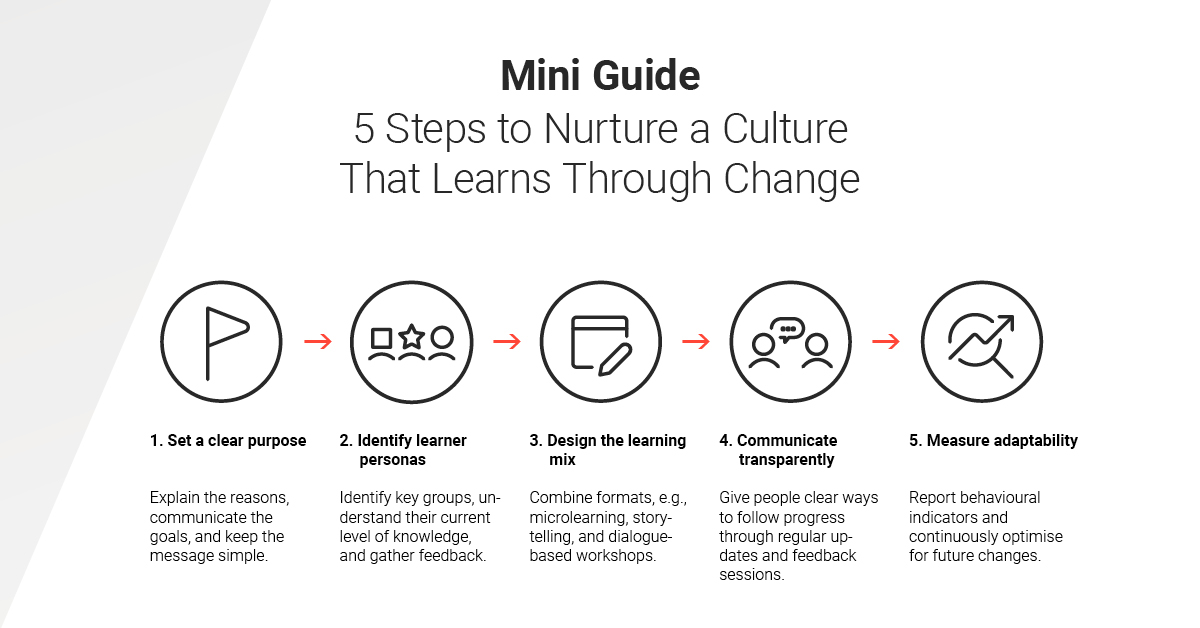
This short guide outlines five practical steps to help teams stay curious, adaptable, and engaged when everything around them is shifting.
1. Set a clear purpose
Before introducing a new system or process, take time to explain whythe change is happening. People respond better when they see the bigger picture and understand how their work contributes to it.
Connect the change to company goals and values.
Be honest about what will improve and what might feel uncomfortable at first.
Keep the message simple and consistent across all channels.
2. Identify learner personas
Different people experience change in different ways. Understanding who needs what kind of support helps tailor communication and learning.
Map out key groups: leaders, managers, end users, support teams.
Find out their current knowledge level and preferred ways of learning.
Use feedback sessions or pulse surveys to check where the biggest gaps are.
3. Design the learning mix
Not everyone learns best through formal training. Combining formats makes learning accessible, relevant, and quick to apply.
Use microlearning for short, focused updates or skills refreshers.
Integrate storytelling to make the change relatable and connect it to real work.
Include dialogue-based sessions such as workshops or role-play to build confidence.
Keep materials short, visual, and easy to revisit.
4. Communicate transparently
People lose trust when change feels hidden or one-sided. Keep communication open so employees can follow progress and share their experiences.
Provide regular updates and highlight small wins.
Encourage two-way dialogue, as questions and feedback show engagement.
Share lessons learned so that others can build on them.
Make visible how feedback leads to adjustments.
5. Measure adaptability
Success in change isn’t only about ticking off milestones. It’s about how well people adjust, learn, and keep improving.
Track behavioural indicators such as collaboration, initiative, and problem-solving.
Celebrate progress publicly, even when it’s incremental.
Collect stories that show how learning helped overcome challenges.
Use these insights to refine future change and learning plans.
Putting it all together
When learning becomes part of daily work, change turns from disruption into growth. A culture that values curiosity, communication, and reflection can face new challenges with confidence — not fatigue.
Keep this guide handy as a quick checklist the next time you launch a change initiative.
It’s a reminder that the most sustainable form of transformation starts with people who are encouraged to keep learning.