imc Agent Builder: Custom AI Agents for Corporate Learning
With the imc Agent Builder, organisations can unlock the flexible, personalised value of AI

The approach: Customisation instead of standard solutions
Fully integrated into the imc Learning Suite (LMS), the imc Agent Builder enables L&D teams to create, manage and continuously refine their own AI agents. The guiding principle is simple: AI delivers real value when it is aligned with specific organisational needs.
“Our customers build their own agents. They know their processes, their data and the people who work with them. That expertise cannot be replaced by generic solutions. We provide the platform, the tools and the methodological guidance.” Christian Wachter, Co-CEO, Scheer IMC
The platform provides a flexible framework for building AI-powered learning experiences, including:
- Definition of behaviour and system prompts
- Freedom to choose underlying AI models (e.g. OpenAI, Anthropic or proprietary models)
- Integration of internal and external data sources
- Configuration of guardrails such as data protection and compliance rules
Pre-built templates simplify onboarding, while organisations retain full control over architecture and implementation.
Three typical use cases
The value of the imc Agent Builder becomes particularly visible in practical, clearly defined scenarios. Importantly, each agent only accesses the content and processes relevant to its specific role.
1. Learning assistance for employees
An employee is looking for professional development opportunities in leadership skills. The agent evaluates prior experience and available learning time, then recommends suitable content directly from the organisation’s internal catalogue — including direct links.
Unlike generic AI tools, recommendations are based on employee preferences, existing knowledge and the company’s actual learning offering, without requiring employees to manually filter content themselves.
2. Support for platform users
Questions about how to use the learning platform can be resolved directly through conversation: “How do I register colleagues for training?” The agent understands the organisation’s specific processes, provides step-by-step guidance and, if required, can either execute the process directly or trigger a support request for a service representative.
3. Support for L&D and administration
The platform also provides operational support for L&D and administration teams. For example, an administrator can ask about existing compliance courses. The agent analyses the available content and delivers a structured overview to support future planning and optimisation.
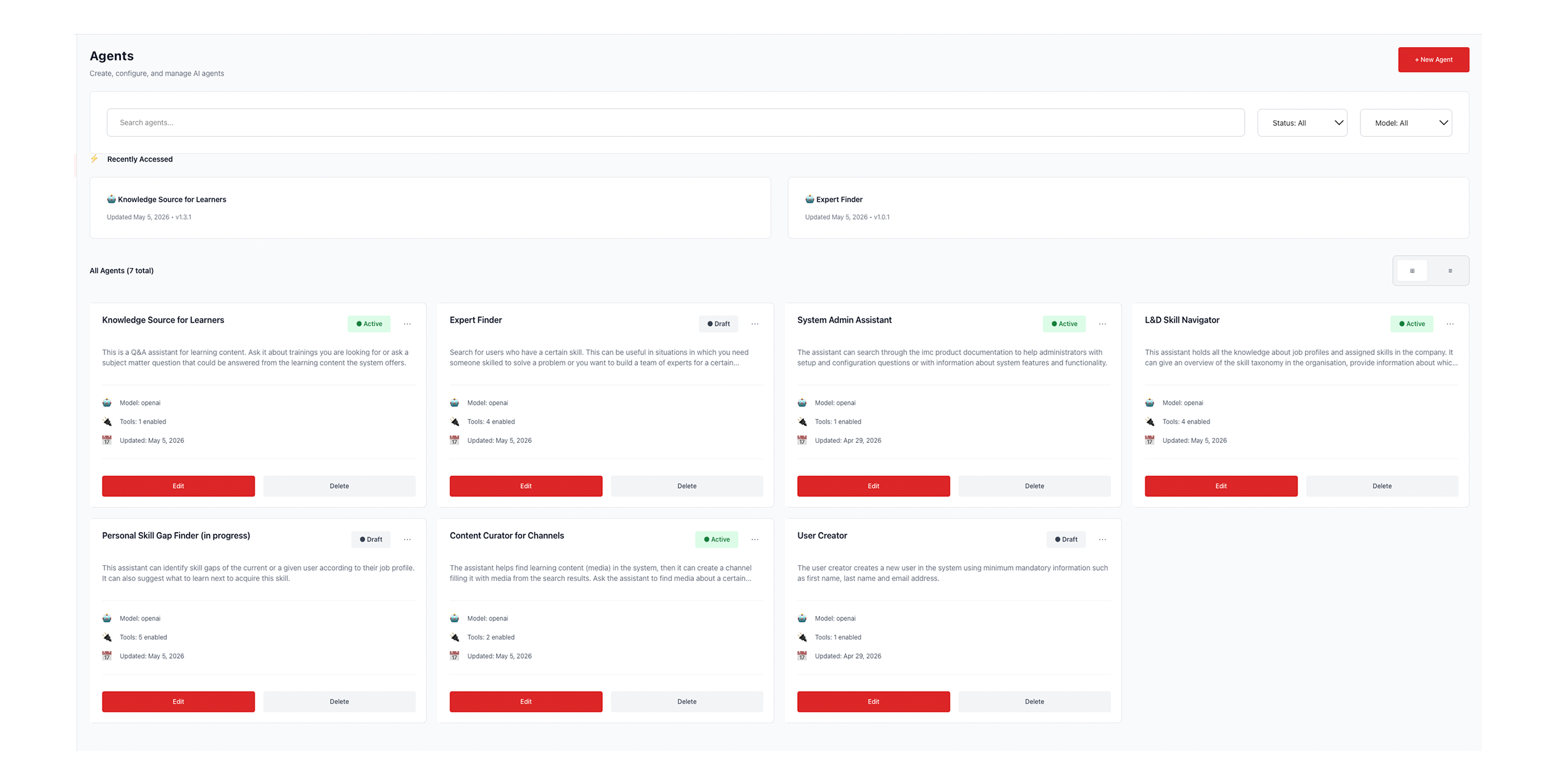
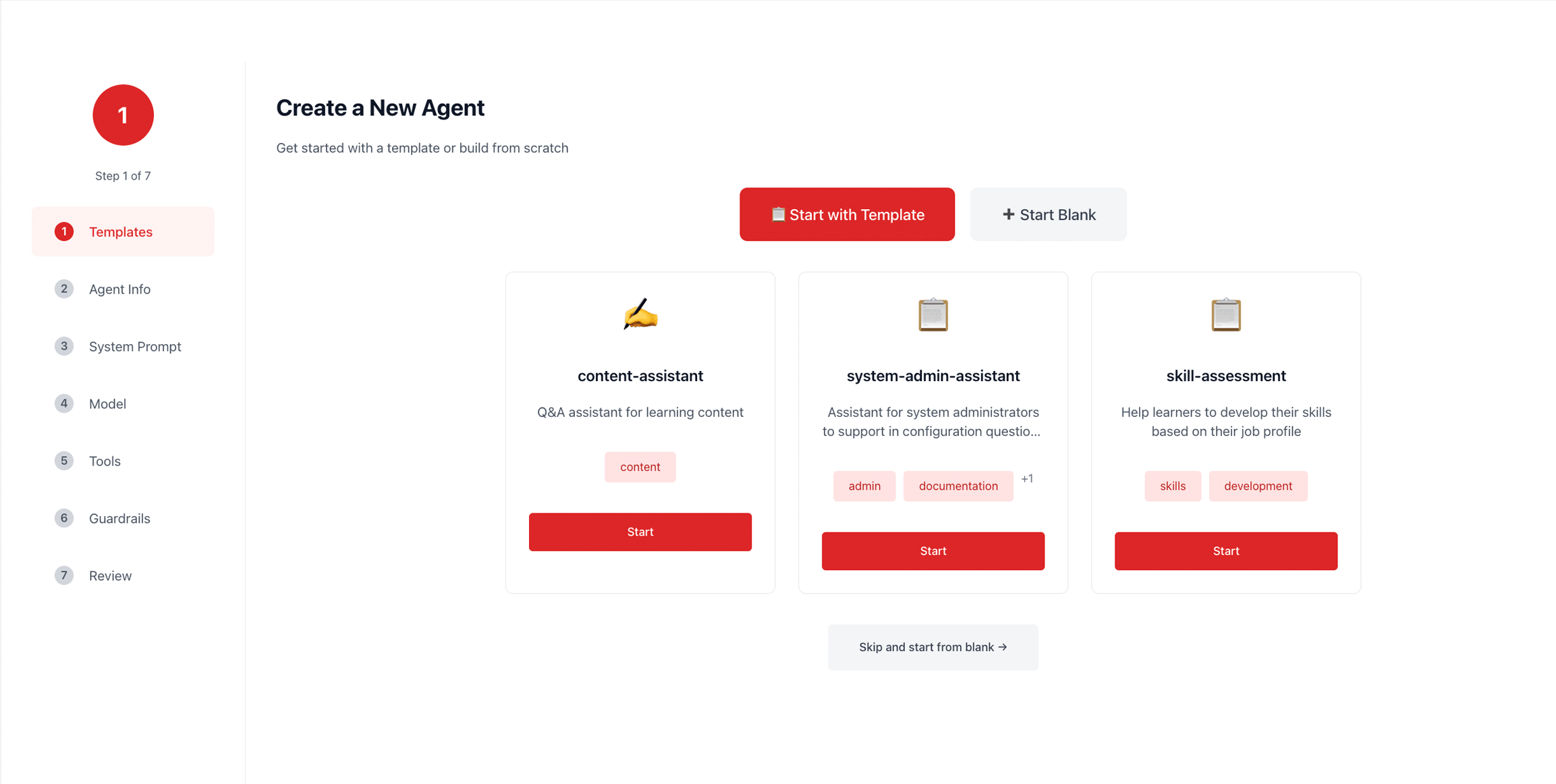
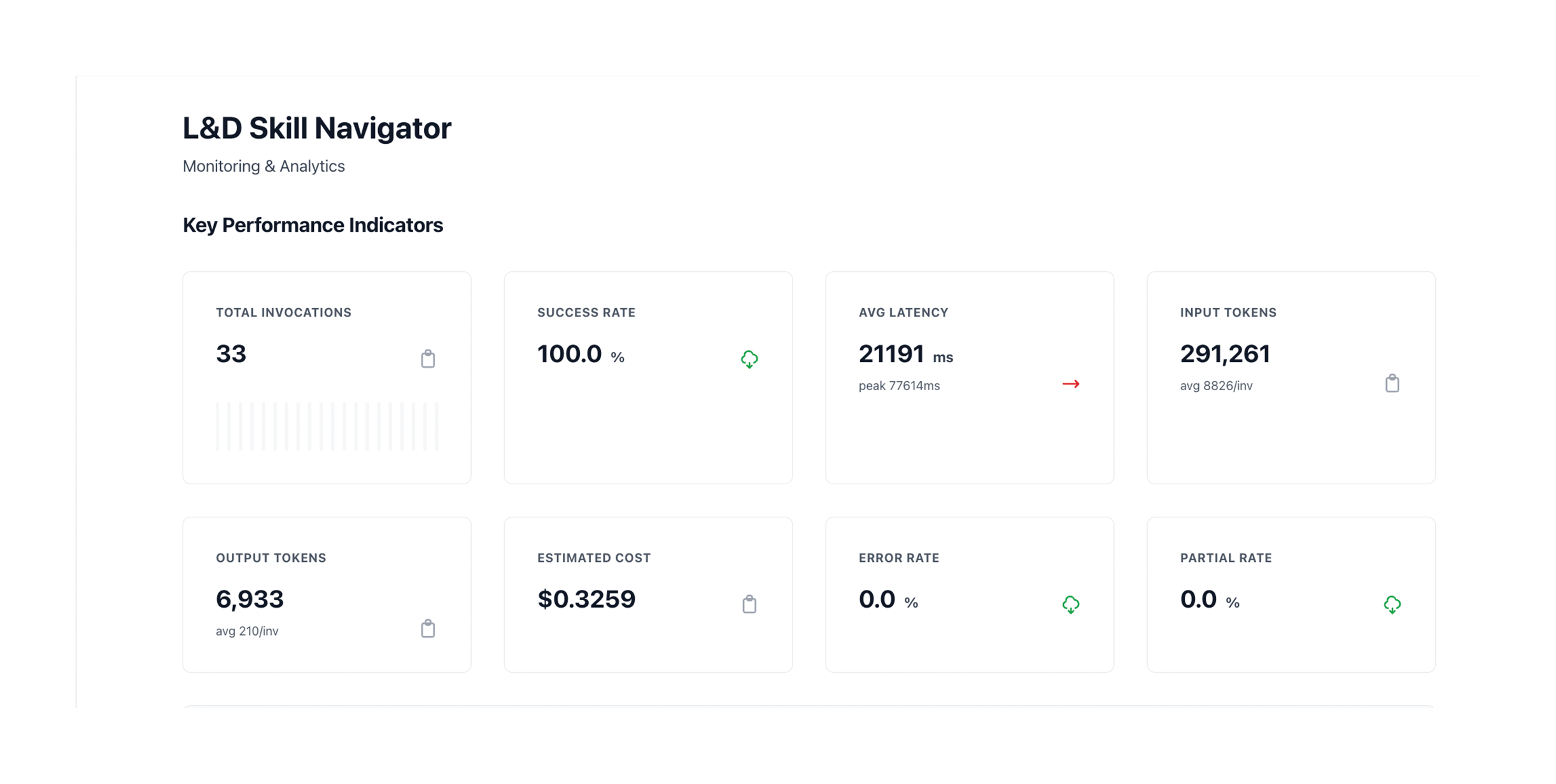

The imc Agent Builder. Create. Configure. Manage.
Technological foundation: Headless LMS
The imc Agent Builder is built on the headless architecture of the imc Learning Suite. Frontend and backend are fully decoupled, with functions and content delivered through APIs. This enables AI agents to be flexibly integrated into different work environments.
“Our agents are not tied to a single interface. They operate wherever employees already work; in the learning portal, the intranet, or service systems.” Roman Muth, CTO, Scheer IMC
This means AI becomes part of existing workflows rather than an additional standalone application.
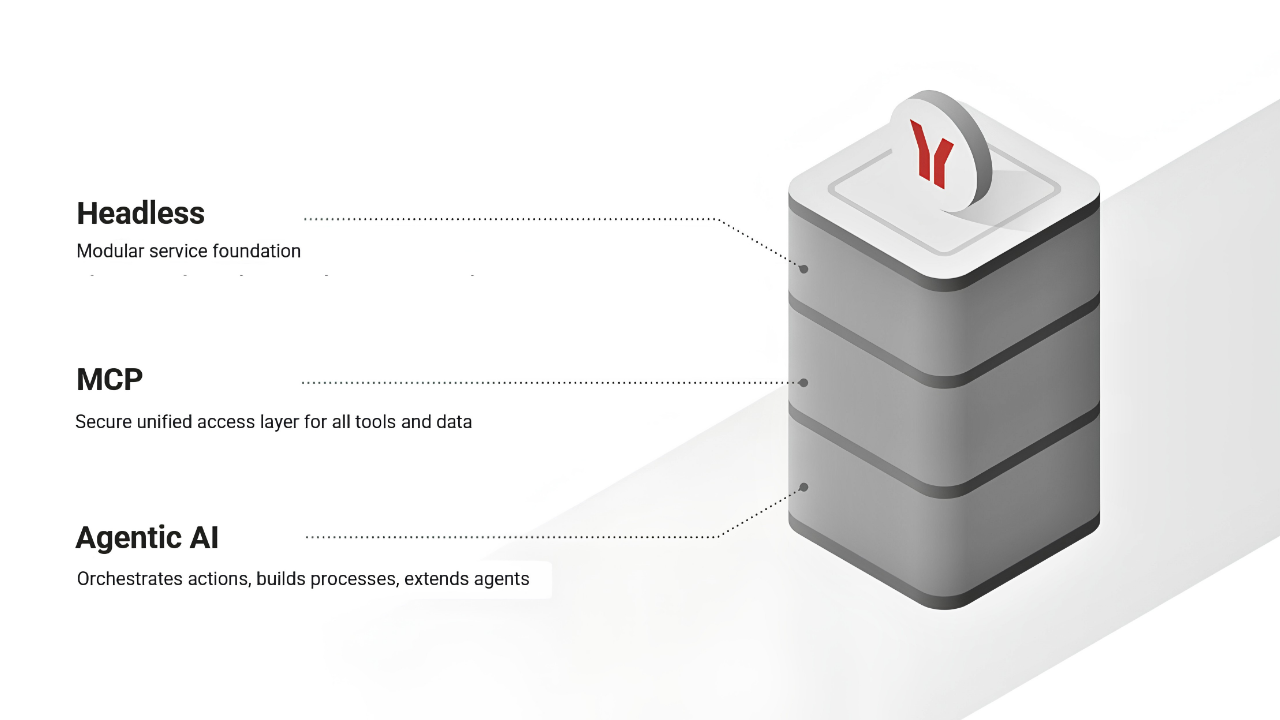
The Scheer IMC AI agent architecture
Integration and governance
Companies can seamlessly connect existing AI agents to the LMS via MCP servers (Model Context Protocol). In addition, agents defined within the LMS can communicate with external MCP servers, allowing flexible integration with additional systems, including:
- HR systems
- ERP solutions
- Knowledge databases
- Custom data sources
At the same time, the platform ensures that essential governance requirements are met:
- Protection of personally identifiable information (PII)
- Filters for inappropriate content
- Configurable access restrictions
Integrated monitoring provides transparency into agent usage and effectiveness, enabling continuous optimisation.
Architectural principle: Specialised agents instead of monoliths
A core design principle of the imc Agent Builder is the deliberate avoidance of a single all-encompassing “mega-agent”. Instead, modular workflows are built from specialised agents.
This structure offers several advantages:
- Better control and traceability
- Greater stability
- Flexible adaptation when processes evolve
“When a process changes, you adapt individual building blocks rather than the entire system. That significantly improves long-term manageability.” Roman Muth, CTO, Scheer IMC
Success factors: Consulting and enablement
Introducing AI into a learning environment is not simply a technical project. Success depends on integration into existing processes and user adoption. That is why consulting and enablement are an integral part of the imc Agent Builder approach.
Implementation follows a structured four-phase model:
- Use case identification: A collaborative analysis to determine where AI can create genuine value within a specific learning context.
- Agent design: Defining the desired behaviour, prompts, data integration and governance structures closely together with the customer.
- Pilot phase: Testing with real users, supported by monitoring and iterative optimisation.
- Scaling: Expansion of the agent ecosystem and integration of additional use cases. The goal is to enable organisations to independently evolve their AI agents over the long term.
What’s next?
Organisations interested in exploring how the imc Agent Builder can support their learning strategy can arrange an individual consultation.
A working prototype was already showcased at LEARNTEC 2026. Initial enterprise customers are currently working with the platform in closed beta programmes. The programme will include an initial AI-powered learning assistant as part of the beta release.

Intelligent AI agents for your learning processes
Want to discover how the imc Agent Builder fits your organisation’s learning processes?

The architecture behind the imc Agent Builder
Interested in learning more about the architectural foundation?