Is Corporate Learning Still Future-Ready Without Competency-Based Processes?
How AI-powered skill mapping transforms enterprise learning into a manageable management function

Enterprise learning faces a fundamental structural shift in 2026: success will no longer be measured by the design of individual learning programmes, but by the actual impact on the organisation. The key is to build competencies where they are needed and to directly support the organisation’s strategic goals.
In the dynamic world of work, standardised learning programmes alone are rarely sufficient, and companies must be able to systematically build, measure, and specifically develop skills in order to remain competitive.
But how do you transform mere training into genuine performance? In this article we explore how to bridge the gap between existing skills and strategic business objectives to turn learning into a genuine competitive advantage.
Standardisation as a key success factor: Bringing structure to your learning processes
Modern competency processes bring structure to corporate learning: creating standardised, scalable procedures for the assessment, evaluation, and development of competencies, ranging from strategic goal-setting and skill mapping to the design and impact measurement of initiatives. It is only this framework that makes enterprise learning manageable for management and provides the necessary data foundation for informed decisions.
Until now, companies have often relied on assumptions, individual analyses or retrospective data when it comes to training, reskilling, or talent development. Employees’ collective wealth of knowledge and experience is scattered across the organisation and is assessed differently depending on the context. Therefore, a shared understanding of the current situation facilitates collaboration between HR and specialist departments, managers, and employees, helping achieve corporate goals.
Enterprise learning as a management tool
Enterprise learning is evolving into a management tool and provides clear answers to key questions: Achieving the goal depends on a structural paradigm shift, rather than additional training programmes. This requires standardised, scalable competency processes based on a unified data model to link learning, skills mapping, and corporate management.
- What competencies are currently in place?
- Which ones will be needed in the future?
- Where are the critical skill gaps – and which measures have been proven to help close them?
The path to success is not achieved through additional training programs, but via a structural paradigm shift. This requires standardized, scalable competency processes based on a unified data model to connect learning, skill mapping, and corporate management.
Artificial intelligence supports these processes, particularly in the allocation, consolidation, and ongoing updating of competency data from role profiles, assessments, and learning activities, as well as from internal systems (e.g. HR) and external data sources such as labour market and benchmark data. This enables skill gaps to be systematically identified and used as a basis for management decisions.

Why skill-scalability is a matter of process
In larger organisations, scalability is less a technical issue and more of a governance and process problem. Whilst learning systems can often accommodate large numbers of users, they do not offer consistently reproducible competency processes.
Typical structural shortcomings can include:
- heterogeneous skill definitions across different business units
- different assessment criteria for comparable roles
- manual, non-auditable assessment and decision-making processes
- a lack of feedback between learning, performance, and workforce planning
Scalability only arises when learning is implemented as an end-to-end competency process with clear standards, roles, and decision-making criteria.
Skill mapping and AI as drivers of scalable competence processes
In an enterprise environment, skills management is not a one-off HR initiative, but an ongoing management process that pursues several objectives:
- Standardisation: Establishing a company-wide skills taxonomy that enables roles, functions and target profiles to be compared.
- Operationalisation: Systematic collection of competency data using standardised, objectifiable procedures.
- Transparency: Aggregatable skill profiles at employee, team, and organisational levels.
- Derivation: Linking skill gaps to targeted development measures.
In large companies, however, this process can only be implemented consistently and at scale through automation.
What AI really achieves in skills management
Artificial intelligence supports skills management within standardised competence processes by scaling up data-intensive sub-steps and enhancing them analytically. It does not take on independent control, but acts as an enabler within defined process and governance structures.
On the one hand, AI supports the standardisation of skill terminology, identifies redundancies, and establishes comparability across organisational units: provided they are based on a common taxonomy. Through the continuous analysis of data from role profiles, assessments, and learning activities, AI is also able to create dynamic skill profiles.
On this basis, competency requirements can be systematically analysed, developments categorised, and relevant skill gaps identified, which serve as the basis for further decisions. Resultingly, skills management is evolving from a predominantly retrospective approach into a data-driven management tool.

Process integration: From isolated, individual processes to a closed-loop system
The critical level of maturity is achieved when skills management is embedded within a closed-loop control system:
- Competency data is continuously recorded and evaluated
- Deviations from the defined target skill level are analysed
- Development measures are derived and prioritised on this basis
- Results are fed back into the updating of competency profiles
- Management receives consistent and transparent decision-making criteria
This control loop makes skills development manageable, transparent, and scalable.
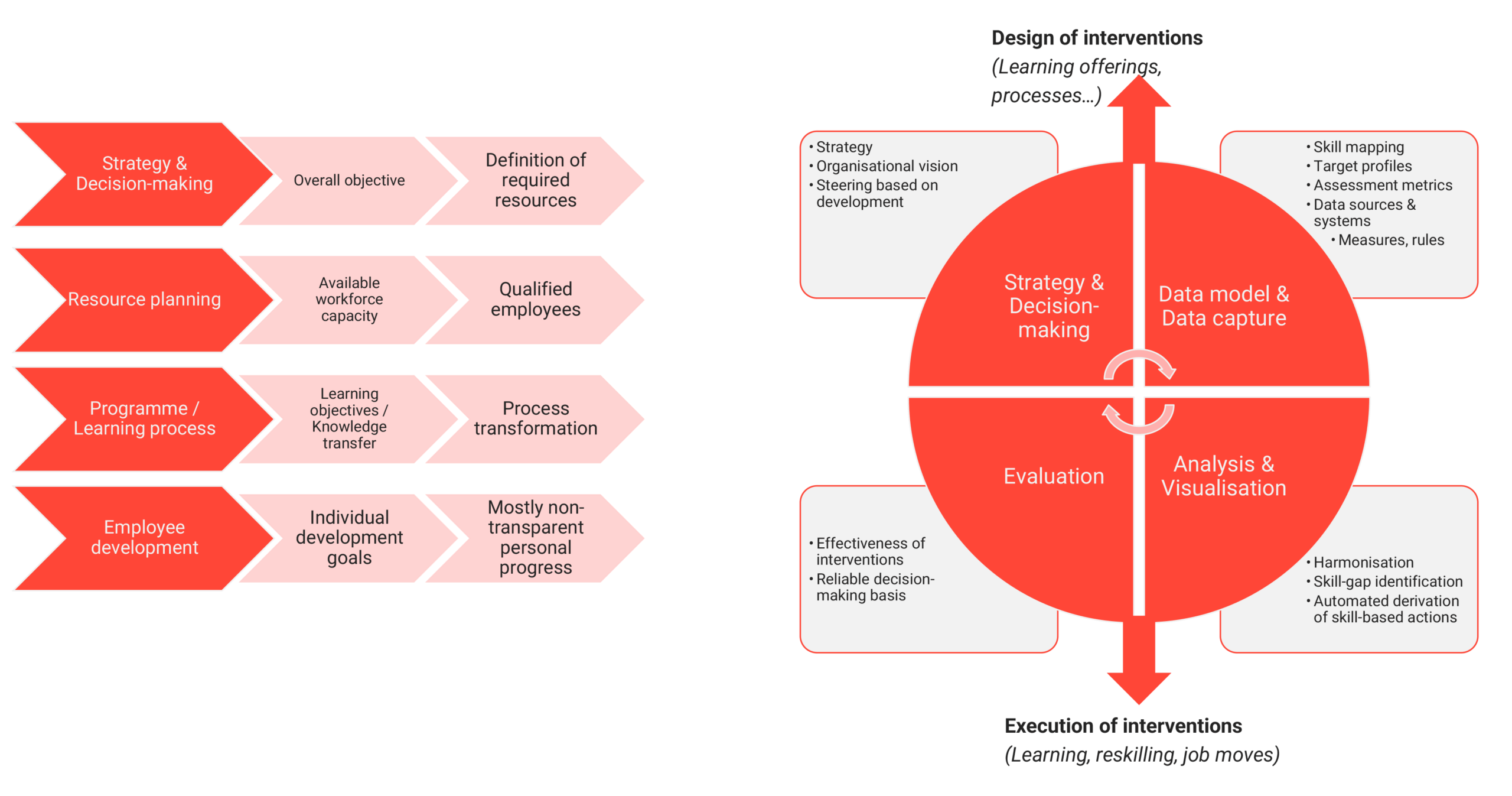
Figure 1: From isolated processes to company-wide competence management – competence processes and a data model link learning, skill mapping and corporate management across organisational units.
A universally applicable and clear data model provides a common foundation for everyone: from the board of directors and HR to managers and employees. It also supports strategic direction and management, skills development, and operational implementation.
Requirements for an enterprise competency architecture
Preparing a learning environment for the future means having more than just a platform in place, but also an intelligent competency architecture based on four pillars:
- A central data layer for competencies and skills
- Integrated learning and HR systems
- AI-supported analytics
- Process and governance structures
The role of the L&D function is thus shifting from operational implementation towards the design and management of company-wide competency processes.
Skill management is becoming a strategic management task
Skill management is evolving from an isolated L&D tool into an integral part of strategic corporate management. This is underpinned by standardised processes and reliable data, which enable competencies to be managed systematically and make decisions transparent. Artificial intelligence acts as a catalyst in this process by scaling data-intensive steps and providing analytical support.
For enterprise L&D, this means moving away from isolated measures and towards processes, data, and tangible impact. Consequently, learning is evolving from a supporting function into a controllable component of corporate transformation and long-term competitiveness.
Dr. Sabine Zander
is Director of the Innovation Lab at Scheer IMC, where she is responsible for the strategic management of national and international research and innovation projects focusing on digital learning and artificial intelligence in the context of corporate learning.
Dr. Mareike Schmidt
Dr Mareike Schmidt holds a PhD in Computer Science and works as a project manager at Scheer IMC, where she oversees national and international research projects in which the imc Learning Suite is used in a variety of application scenarios.