Interview: How AI Is Redefining
Sales Enablement
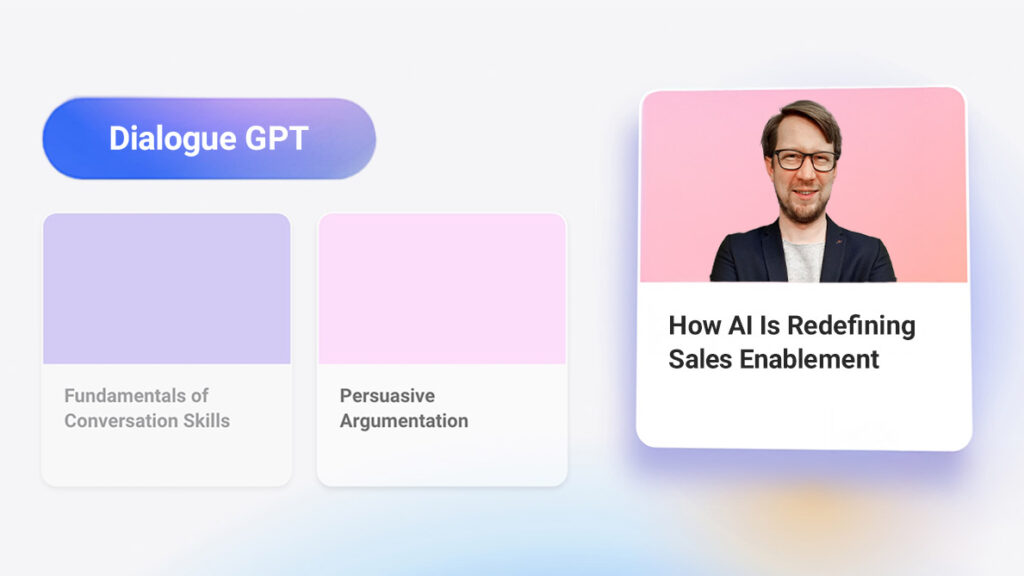
Sales enablement: Dr. Robert Lohmann on how AI is evolving training in sales
Artificial intelligence is rapidly reshaping the way sales teams learn, practise, and perform. Across the industry, research from Forrester and others shows that the most effective enablement programmes are moving beyond classroom-style training and more towards intelligent learning experiences that are adaptive, contextual, and continuous.
While some organisations focus on predictive analytics or content automation, the most immediate impact is coming from AI that improves human interaction. The ability to simulate real conversations, practise challenging dialogues, and receive instant, constructive feedback is helping sales professionals refine their skills in a way that’s both scalable and personal.
At Scheer IMC, this is exactly what we focus on with DialogueGPT: our conversational AI solution that transforms communication training. It allows teams to practise realistic sales and customer interactions in a safe environment, receive tailored feedback, and build confidence before stepping into the real world.
To explore how conversational AI is transforming sales readiness, we spoke with Dr. Robert Lohmann, Product Manager for DialogueGPT, about how this technology is changing the learning experience for modern sales organisations.
He shares practical tips for building effective partner enablement programmes, warns of common pitfalls, and provides an outlook on the potential of AI-supported learning.

Everyone is talking about AI in learning right now. From your perspective, what’s really changing in sales enablement?
What we’re seeing in sales enablement is real, fundamental change: AI doesn’t just make content creation faster – it changes how we learn. Instead of one-off trainings that often get forgotten quickly, sales teams can now train continuously with real work context.
For me, people remain right at the centre: AI doesn’t replace training, it enhances it. Through it, we can enable realistic conversation simulations, for example with DialogueGPT. This allows sales professionals to practise typical scenarios – negotiations, personal presence, sharpening messaging – as often as needed. This is training, not with a sole theoretical focus, but that incorporates experiential learning tailored to their industry or even specific customer cases.
This radically changes learning: We’re no longer just consuming content, we’re learning by doing. And that’s what makes AI so valuable in a sales environment.
Many companies still rely on workshops and classic role play scenarios. How does conversational AI improve this experience?
Traditional workshops and role plays still have their place: for example because human coaches provide feedback that AI cannot. Our AI-powered coaching, such as DialogueGPT, complements these trainings perfectly and adds extra benefits.
The advantages are clear: Employees can practise anytime, anywhere with no scheduling, time, or location constraints. Most importantly, they can experiment in a safe environment. Not everyone feels comfortable training in front of a group or a coach. AI offers a secure space to try out new approaches, draw conclusions, and build confidence.
Plus, the training is scalable: Human coaches are expensive and their time is precious! AI makes it possible to extend training to many employees at once without losing quality. This makes learning more flexible, frequent, and effective – the perfect complement to traditional training.

AI-based feedback sounds promising, but how do you ensure it’s credible and truly helps people improve?
Our AI-based feedback is grounded in proven communication psychology theories, such as those of Friedemann Schulz von Thun, as well as the Harvard Concept, which are combined with our own training expertise.
The feedback combines structured insights with narrative explanations: Employees see what works well and where they can improve. The system was developed together with learning experts and customers to ensure it’s practical and human-oriented.
Security is also key: Real customer data is never used, and all responses are handled securely. At the same time, feedback can be tailored to a company’s own communication models. This creates a reliable, transparent, and trustworthy learning tool that truly drives sustained learning and improvement for employees.
How will conversational AI change the concept of “sales readiness” in the future?
Conversational AI will radically change sales readiness. Instead of isolated training events, sales teams will train more continuously and in context – exactly when it’s needed. Learning in the flow of work means: If you have a client meeting at 10 a.m., you can already start preparing with your very own personal AI coach at 9:30 a.m. Training becomes flexible, on-demand, and highly practical.
Employees can prepare for specific conversations, test different scenarios, and get instant feedback, right when it matters. Expertise grows continuously because learning is tightly integrated into daily work.
And this is just the beginning: Future developments will include gestures, facial expressions, and emotions, with avatars enabling virtual negotiations on camera. Scheer IMC is leading the way with its DialogueGPT team to integrate these innovations into training and take sales readiness to an entirely new level.
Learn more about the capabilities of DialogueGPT
Read more about what makes DialogueGPT such an easy, effective, and scalable tool below, or explore our case study with Festo, a leader in pneumatic and electrical automation, to see how AI-supported communication training drives excellence in a leadership context.